Math the final frontier. OK here is a “try this at home” experiment. Draw a triangle in a piece of paper. Now make a random dot anywhere on that page. Now from that point you’ll go half way to a vertex (one of the points). To figure which vertex to head towards let’s choose a random direction- roll a six sided die, if it lands on 1 or 2 go to the “bottom left” point, if it lands on a 3 or 4 go to the top, and if it lands on a 5 or 6 go to the bottom right point.
Now do a few dozen rolls each time going from halfway from the previous point you made to the direction- you will see a bit of an outline forming. In fact, if you do a few thousand iterations you will begin to notice that you’ll see the triangle filling in. When you look at it you’ll see a very strange effect- there will be gaps where no points end up. What is really weird is if you zoom into one of the triangles that make up the big one it’ll be an exact version of the one you started with and you can actually zoom into it and keep zooming forever. It is weird.
What you are seeing is an example of Sierpinski Triangle, which is the name of the shape. This whole mathematical system evolves regardless of your starting conditions of what point you start with and which vertices you move towards. This is called an “Attractor” and it is the first of a series of interesting mathematical models. There are more forms of attractors which lead to “Strange Attractors” which lead to “Fractals” which I’ll likely play around with soon.
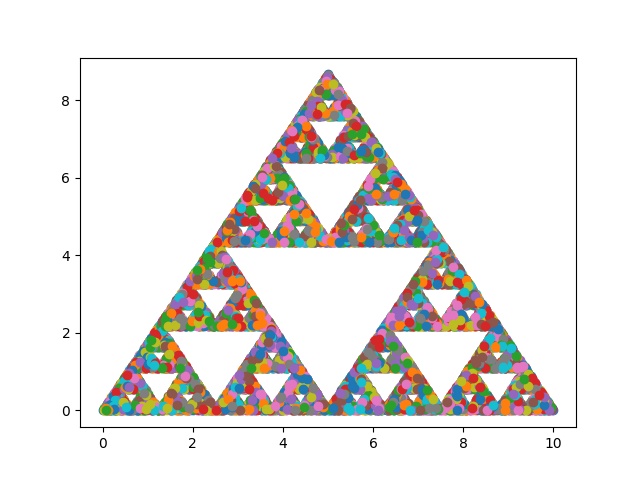
I watched a YouTube video on the math behind it and I just had to try to see it in action myself, so I wrote a program in Python (a popular programming language). I potted 15,000 plots after giving it a single starting point. Each direction to go in was chosen randomly by the computer, now if I use smaller plot points, you will see a bit more detail, but I like the gumball look it has personally.
Here is what I ended up when I ran my own program, this example has those 15,000 points plotted:
The general algorithm is this:
-Ask for a starting X and Y coordinate.
-Identify first ‘plot points’- the three vertices of the triangle and the user entered point
-Print confirmation of the points and start graphing.
-Choose a random direction (vertex one, two or three) and go halfway to it and plot it
-Repeat this for as often as you like (in my actual code below it states 100 iterations but you can adjust)
-Plot each point
Now what you will end up seeing is pretty much the same thing I plotted above, you’ll be plotting it point by point so what you’ll see is the actual data showing up. It was a fun project for a few hours and let me get back to Python a bit which is a super easy to pick up programming language. If you want to download the code for yourself please check out my GIthub link for this project here https://github.com/ericcrichardson/PythonFun
It is pretty much impossible to get through a day without running into a “smart” device, be it in your home, on your person or moving through your day. Smart homes and smart devices have been subtilty becoming more and more popular. While I have written about some of the risks, which you can mitigate these devices really do make your life easier, they can help you save money or feel more secure. See my article on being cyber safe at home here: https://ericcrichardson.com/2021/01/28/home-the-cybersecurity-dangers-within/amp/
While there are many ways to think about what makes a “smart device” to narrow it down I’ll first speak to the following criteria.
-It must be some sort of electronic device (battery, plug, solar)
-It needs to have a degree of connectivity (WIFI, Z-wave, Bluetooth etc.)
-It must have a way to communicate to it from distance (via phone, via computer etc.).
Behind the scenes, these devices all communicate with either a service or another device it is paired with and in many cases both. You can either read information or adjust some sort of setting. While the list of possible choices I am going to use personal experience and what I’ve worked with to speak to some of the ways smart devices can help you out. I’ll speak to phones, tablets, computers as connectors to the devices and displaying data; while they are all part of the ecosystem, they help you manage these devices but are not the devices themselves.
Smartwatch
The Smartwatch may be the closest device as you wear it. I wear a smart watch nearly 24×7 and I have for years from different manufacturers starting with a smart band and working up to a full watch. I have what is very much for me a “head up display” for what’s going on with my phone, I can configure E-mail notification, phone calls, meetings, etc. to display on my watch. It’s my ever-present step counter, I can set it to track workouts when I jump on the elliptical or treadmill in lieu of going out during staying at home for COVID. It also tracks my sleep, heartrate etc. so I have good baseline for how things are with me. I see news headlines on it and then then open them up on my phone so when I unlock my phone it is waiting for me. It also tells super accurate time as it syncs with the phone which itself synchs to the wireless network which has very accurate time. Lastly- I love analog watches so my watch displays hands. I have never liked the look of digital watches, so I get the best of both worlds.
Smart LED Lightbulbs
LED light bulbs are not at all new, they can provide excellent light at a fraction the cost of old style incandescent light bulbs and they produce nearly no heat. While LEDs have been around a long time the last decade has seen an explosion of the use of them now taking the lead as the main lightbulb in households and businesses. There are several manufactures of LEDs for the home which can product bulbs that have the same warm light as an old-style bulb as the lighting manufacturers have figured out how to alleviate that harsh white flicker. In addition to that multiple LED manufacturers have equipped their bulbs to work on a network, often you must purchase a hub (like a wireless router) which communicates to the lights. The hub is itself pugged into the household network. Now you can, from your computer, phone, or tablet control the lighting in your house. Ever worry about “did I shut off the kitchen light?” Even from the other side of the world you can check to see if your lights or on or off.
You can use Internet services such as “If this than that” (IFTTT.com) to create automatic steps (Applets) which occur, such as when you get within a certain distance of your house to turn the external lights on. It’s very easy to do and has great value. Having the exterior lights turned on when I near the house is especially useful feature for me in winter.
Check out the section below about smart speakers for further integration to the smart house.
Smart Thermostat
Smart thermostats simply replace your existing thermostat, they will often connect to your house WIFI and thus to a cloud service. A smart thermostat does let you adjust the temperature up and down all you want from anywhere using a computer or phone, oddly I almost never actually tough my smart thermostat anymore as I always have a computer, tablet, or phone nearby!
I feel the “Smart” comes from the connection to the cloud and the calculations that are done to identify when it is needed or not. The thermostat with then adjust the temperature up and down based on usage patters so you can ‘train’ it to get cooler at night and use electricity. I’ve had a smart thermostat for several years and I have seen a reduction in my energy use.
Smart camera
Smart cameras are all about security. There are versions made for in us out of doors which have features such as microphones and speakers so you can potentially talk to someone at your front door if you are somewhere else. They often have motion sensing built into them and can identify the difference between a motion (say a dog runs through your yard) or a human face. They can also record what is happening so you can review it later.
Robot servants
Robot servants, the never realized hope of a century of sci-fi movies. Today we see some interesting things from some of the companies developing commercial grade robots, just do a web search for Boston Dynamics “dancing robots” but how about for the home?
Today one of the only viable options for a home robot is a roving vacuum cleaner. There are some educational robots out there and some toys, but we are not there yet. There is some early work in lawn mowing robots, window washing robots or even pool cleaning robots. They tend to be expensive for what they do- but give it about ten years.
Smart Speaker
The Smart speaker has become something many homes have, in fact it is not uncommon to see homes with several. In truth the ‘smart’ is the service running in the cloud which the speaker, or app communicates to. It can take your grocery list, it can read you weather, show you YouTube videos. What started out with Cortana from Microsoft on Windows and Siri on Apple phones have mostly been overtaken by Echo from Amazon and Google Home from Google.
The power of whatever smart device you use is the cross-connectivity between the speaker or app and the other smart devices in the eco system. With smart speakers and/or IFTTT you can create automatic steps what will occur when certain criteria are met. For example, when I tell my smart speaker “Good night” It’ll shut off all the lights in the house, set the thermostat to a night time setting and reply “Setting the house to night Mode” to confirm that’s what is happening- it’ll then flip the porch lights on full bright white for security. The devices also come in some strange form factors like clocks or plugs, but that means they can be cheap and ubiquitous in the house which means you’ve got an instant home announcement system built in.
There are so many other devices such as smart ovens, smart refrigerators, smart locks, smart doorbells etc. so I recommend you look around for what is out there! To me I really saw the power of them when I started connecting them to my different smart speakers/apps. I personally actually have Cortana, Google Home, and Amazon echo set up so I can accomplish whatever I want in front of any device. But be smart about y our set up, for example take smart steps to protect yourself, use smart password discipline. You can read about how to manage passwords here https://ericcrichardson.com/2021/01/14/the-gist-of-passwords/amp/
Bitcoin, the name evokes thoughts of something having to do with currency or an investment, but it is hard to pin down, it seems to be in the realm of those well versed in high tech. As the price of cybercurrencies fluctuate they make the news, usually talking about an isolated case where someone either suddenly lost or gained a huge amount of personal wealth. So, let’s take a minute and establish just what Cryptocurrency is, and isn’t.
There was once a time where countries wealth was tied to the amount of physical gold they had, and coins used to be made of that gold in fact. Eventually the world evolved, and we had paper notes which represented the gold without changing hands. The paper money was directly linked to the gold and silver wealth of a country, in the US just a hundred years ago you could actually exchange your bills for an equal amount of gold in certain situations. Eventually the gold and silver “notes” stopped being honored. Then the physical currency had no value other than the value that it is assigned and supported by those using it. In a strange way our current currency only has value today because we believe it does, there is in fact nothing directly tied to supporting it. This is known as a fiat currency, that is a currency which is not backed up by any commodity. Therefore, if you believe it has value, and your society does then it does in fact have value.
Cryptocurrency is itself a Fiat currency, but it’s not supported by a government it’s supported by those using it. In that aspect it is no less “real” a currency than most major currencies in the world. The first Cryptocurrency was Bitcoin, and that is still by far the big dog in the pack. As of today, Bitcoin has capitalization of over 600 Billion (US Dollars). The roots of Bitcoin, which for years was the only Cryptocurrency, started in 2008 when a white paper was published by an enigmatic figure in Cryptocurrency named Satoshi Nakamoto. Nakamoto may be an individual using a pseudonym or a group of people, we don’t know. The Nakamoto paper however articulated a method to decentralize control of Bitcoin by using an anonymous based process with strongly enforced record keeping.
Cryptocurrencies are decentralized– They differ from other Fiat currency by not having a physical manifestation. But that also means banks and governments cannot control it.
They are anonymous– You can prove you are an entity (person, company, government) with value in cryptocurrency but there is no way to track it back to an individual.
Encryption– this is where the “crypto” part of the name comes from, by using cryptography it is nearly impossible to crack unless someone is careless and does not secure their private key (a long unique series of characters).
Transactional based- Every transaction for Crypto currency is recorded in effectively a ledger, but a digital one, and effectively copied time and time again and any future transaction must check against all those blocks of data (I’m simplifying quite a bit here), but that’s were “block chain” comes from. If you try to inject bogus data all the other blocks of data out there would, when compared to, identify it as false.
Where do they come from? In Cryptocurrency the ‘cryptocoins’ exist in a finite amount, they can only be found by performing exceeding intensive processing which adds more cryptocoins to the amount which can exist. This is called cryptocurrency mining and is similar to precious commodity mining in the sense there is a finite amount of these digital currencies which can be uniquely identified, and it takes quite a bit of work to do it. Many people started working their home computer’s running these calculations and they realized they needed more and more computing power. So eventually people began to use graphic cards to do this, as they are just math processors used to calculate the geometry of which is shown on the screen very fast. If you remember Graphic Processor Units (GPUs) suddenly becoming exceedingly expensive several years ago- that is why. They are excellent at doing calculations extremely fast, but gamers couldn’t play the games they wanted to as all the high end graphics cards were running calculations. There are cloud companies out there who do nothing other than supply processing power to cryptocurrency miners. The reason people mine is they get paid a bounty on new cryptocurrency they find, the more computers running more equations equals a higher pay out. Then as the market fluctuates, they make and loose money without having had to actually buy crypto currency, of course they would have spent quite a huge amount in computing power but that is a tangible asset you can re-task eventually.
So now we have lots and lots of Crypto currencies, as of today a single bitcoin is about $33,600 but there is a great deal of volatility in crypto currencies. While they are being accepted in more and more places, many individuals simply invest in them like a commodity. The volatility can be breathtaking.
In 2017 there was a huge boom in Bitcoin specially reaching a then unprecedented high of nearly $20,000, only to lose nearly 50% in the next few days. Due to a variety of issues the crash continued all the way down to $6000 a Bitcoin in February. But in 2020 and into 2021 we have seen an all-time high of $40000 per Bitcoin a month ago and y backed off from hat high about 20% but as I write this it seems to be leveling at the $33K US level.
I think of cryptocurrency very much akin to precious metals in many ways, they are commodities, and their value will increase or drop dramatically over time. It’s an investment, but you can use cryptocurrency to purchase goods and services in more and more ways daily. I do think it is here to stay.
If you want to try to get into cyber currency in a “safe” way I would recommend using “Coinbase” which is a digital currency exchange, which means you can buy one or many different cryptocurrencies. If you join you will get $10 worth of free currency deposited in your account, you can then grow it or cancel and just take the $10 (or that much in your local currency) by clicking here: https://www.coinbase.com/join/richar_h9v
Please know that it’ll take up to 24 hours for them to actually deposit the money, I tested this myself and it did take a day for it to show up. In these trying times who am I to say “no” to free money, it’s a coffee or so and I never turn down an opportunity for a coffee! It’s not going to make you rich, but as it costs you nothing you can get the feel for it and if you wish, invest in it just like gold or platinum.
In the last year we have seen the world ravaged by COVID 19 killing well over 2 Million people. Modern medical solutions have been stretched to their breaking point nearly everywhere during the pandemic. Something which has helped those on the medical front lines is technology. Tele-medicine has allowed millions to converse with their doctor via a video call thus reducing risk for all the patients as well as health care providers. Digital prescriptions allow the doctor to directly contact a pharmacy so the patient can just walk in or drive up to and receive their prescription once again reducing COVID risk. The new frontier in medicine is technology.
Today I’ll speak to the connected medical world in which we live and potential risks that you can try to mitigate with planning and vigilance. In many articles I have written I have spoken about Internet of Things (IoT), which are all those connected devices in your household. They make life so much simpler and easier but there are risks, but you can mitigate risk with your connected household devices. See my article on Home cybersecurity risks here: https://ericcrichardson.com/2021/01/28/home-the-cybersecurity-dangers-within/amp/
Just like in home devices we have a class of connected devices which can help you manage your medical needs; these are called the Internet of Medical Things (IoMT). These range from more simple devices like pedometers (step trackers) to sports bands or watches up to much more complex devise which could monitor something like fall detection devices. The more complicated devices will generally need FDA approval in the US or other similar organizations in different countries such as Health Canada. The good news is the federal agencies such as the FDA/Health Canada/Ministry of Health all are evolving and increasing their guidance on cybersecurity before a device even launches and then after it launches.
But there are always things which can be improved. Think about devices you may have in the home that serve medical purposes which a Doctor can read data on and possibly make updates. Things like implantable hart pacemakers or external insulin pumps come to mind. Some of these devices have Bluetooth connections which then communicates with a smartphone and then back to the doctor. Some devices like CPAP machines use 3G technology to wirelessly connect to a mobile phone network to send data, these can also have Bluetooth connections to allow for configuring.
Any time you have a connection you have risk, that is what you need to remember. There have been documented cases of devices being hacked, just do a web search for “Insulin Pump Hack” and you will read about guidance from the US FDA on risks. The risk is not super high but it’s very real. If you have a concern the best way of course is to stay at home- why? Bluetooth only has a 30 foot/10 Meter range.
If you are overly concerned and must travel, there are some things you can do–you can purchase “RFID Blocking” clothing, to protect any implantable devices. these garments are designed to stop reading of RFID chips (Radio-frequency Identification) which is a technology to track tags which is a cheap sticker with a special metal on one side forming a small radio transponder. When you check into a hotel often the keycard you get uses an RFID, it is ‘scanned’ at the door. Well RFID can be scanned at a longer distance depending on how it is configured so if you have anything with RFDI you can block it with these clothes. RFID blocking apparel has a metallic material in it to block radio signals- it also means you will not be ab le to connect to whatever device you have implanted while you have the garment on but it’s a tradeoff. You can read about tips you can consider while traveling being a Cyber Secure Traveler here: https://ericcrichardson.com/2021/01/18/the-cyber-secure-traveler/amp/
I’d recommend taking general IoT safety steps first which should help ensure you are already being safe with your connected devices. With a bit of work and planning you can reduce your risk profile quite a bit.



 Eric C Richardson