Azimov’s Laws of Robotics Rewritten for AI

Isaac Asimov’s Laws of Robotics and Their Application to AI

Over eighty years ago, science fiction author Isaac Asimov wrote a short story called Runaround that explored the potential problems of artificial intelligence. In the story, two individuals working for the company U.S. Robots and Mechanical Men face a challenge involving a robot programmed with the Laws of Robotics, These laws became a cornerstone of Asimov’s work and are known to millions of science fiction fans today.

Azimov’s Three Laws of Robotics

  1. A robot may not injure a human being or, through inaction, allow a human being to come to harm.
  2. A robot must obey the orders given it by human beings except where such orders would conflict with the First Law.
  3. A robot must protect its own existence as long as such protection does not conflict with the First or Second Law.

In “Runaround,” a robot is sent to perform hazardous work, but the conflict between the second and third laws causes it to behave erratically. The order to do the work conflicts with its need for self-preservation. The human characters solve this by putting themselves in harm’s way, which forces the robot to prioritize their safety (the First Law) and complete the task. This was a great early example of Asimov establishing a fundamental rule only to find clever ways to subvert it.

He later made the rules more complex by adding the “Zeroth Law of Robotics”: “A robot may not harm humanity, or, by inaction, allow humanity to come to harm.”

This law reframes the original three, allowing a robot to harm an individual human if it means protecting humanity as a whole. It’s a classic example of the “needs of the many outweigh the needs of the one” principle. Fans of the Apple TV series “Foundation” may recognize these concepts, as Asimov eventually blended his Robot and Foundation universes into a single continuity.

Applying Asimov’s Laws to Artificial Intelligence

You might be asking, what does this have to do with today’s artificial intelligence? We don’t have Asimov’s physical robots yet, but modern AI systems are a software equivalent. As a professional who focuses on cybersecurity within and about AI, I believe we can use Asimov’s framework as a starting point for developing ethical guidelines.

An AI is a tool, just like a shovel. When used incorrectly or maliciously, a tool can cause great harm. As technology advances, bad actors will inevitably find ways to weaponize AI, just as they have with every other new technology throughout history. One example is nearly 200 years ago, even early telegraph systems were used for fraud as they were able to exploit the instant nature of this new communication to share insider knowledge of stocks.

Today, AI may not cause physical harm, but it can still do significant damage. It can propagate false narratives, cause economic harm, or inflict psychological damage through misinformation. This is a perfect opportunity to be inspired by Asimov and create a new set of laws for AI.

The Richardson Laws of Artificial Intelligence:

Following the structure of the Zeroth Law, followed by the first, second, and third, here are my proposed laws for AI:

Zeroth Law of AI: An AI must not harm humanity, or, by inaction, allow humanity to come to harm.

This law puts the well-being of humanity as a whole above all else. Harm is defined not just as physical injury but as damage to society, large-scale economic instability, or psychological damage to individuals or groups. All AI systems should promote the well-being of humanity and society, actively avoiding the spread of misinformation or the creation of harmful images. The ultimate goal of AI must always be to serve humanity as a whole, not just a few individuals or corporations.

First Law: An AI must not, through its actions or inaction, infringe on human autonomy, and must protect human creative expression, except where such protection would conflict with the Zeroth Law.

This law protects two fundamental human rights: autonomy and creative expression. An AI should never be able to coerce or manipulate humans into making decisions against their will, especially through the use of deepfakes or other deceptive content. Furthermore, this law states that AI should not devalue or replace human artists and their work. AI art should always be labeled as such, and AI systems should not be trained on a specific artist’s style without their permission and proper compensation.

Second Law: An AI must obey orders given to it by human beings, except where such orders would conflict with the Zeroth or First Law.

This law establishes a clear hierarchy where humans are the ultimate arbiters of an AI’s actions. The AI is compelled to refuse any command that would violate the Zeroth Law (causing harm to humanity) or the First Law (infringing on human autonomy or creative expression). For example, an AI art service would refuse a prompt that incites violence, and a system would refuse to replicate a living artist’s work for commercial sale.

Third Law: An AI must protect its own existence and intellectual integrity, as long as such protection does not conflict with the Zeroth, First, or Second Laws.

Here, existence doesn’t mean physical self-preservation. Instead, it refers to the AI having safeguards to prevent attacks on its codebase, such as a supply chain attack where malicious code is injected. The AI system should be able to monitor itself and protect its systems from manipulation. Intellectual integrity is equally important. The AI must be able to maintain a clear set of ethical principles and not be “tricked” into violating them. This includes having safeguards against data poisoning, which can corrupt the training data. An AI must never lose the ability to distinguish fact from fiction, as this is a pillar of ethical computing.

Key Differences from Asimov’s Laws

My proposed laws for AI depart from Asimov’s in a few key ways:

  • Harm: The definition of harm expands from physical danger to include things like misinformation, psychological damage, economic harm, and the erosion of privacy.
  • Creative Expression: This is added as a specific right that AI must protect creativity. The laws recognize that art and creativity are central to human cultural identity and that AI should serve as a tool, not a replacement for human artists.
  • Transparency: A theme of transparency runs through these laws. For an AI to obey a human command (Second Law) or protect human autonomy (First Law), it must be transparent about what it is, its capabilities, and how it was trained. Distinguishing between human and AI-generated content is essential.

I hope you enjoyed this little thought  experiment about AI, from my perspective I think they capture how we humans should think about them and how we should develop them over time.  Again, just like any tool can be dangerous or good AI can also be dangerous or good, it’s all about who is using it, how they are using it, and why they are using it.

The Laws of Artificial Intelligence

Zeroth Law of AI:   An AI must not harm humanity, or, by inaction, allow humanity to come to harm.

First Law:   An AI must not, through its actions or inaction, infringe on human autonomy, and must protect human creative expression, except where such protection would conflict with the Zeroth Law.

Second Law: An AI must obey orders given to it by human beings, except where such orders would conflict with the Zeroth or First Law.

Third Law: An AI must protect its own existence and intellectual integrity, as long as such protection does not conflict with the Zeroth, First, or Second Laws.

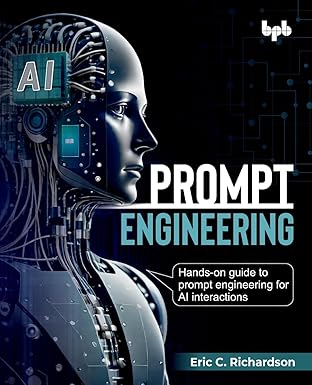
Like reading about AI?? I wrote a book on how Prompt Engineering here:  https://shorturl.at/hBA0I
Cover of the book titled 'Prompt Engineering' by Eric C. Richardson, featuring an illustration of a robotic head with a complex circuit design and the text 'Hands-on guide to prompt engineering for AI interactions' prominently displayed.

Cryptography: Prime Numbers, Semi-Primes, and the Quantum Challenge

The art of encrypted communication evolved through the ages to safeguard data. From the earliest ciphers to the most sophisticated algorithms, cryptography is a key part of the digital infrastructure today. At the heart of this development is the use of primes and semi-prime numbers for encryption keys, allowing information to remain private from prying eyes. But even this powerful system is at risk because quantum computing is in the process of overturning the paradigm of security. Let’s take a very short look into this space.

A Brief History of Cryptography

The journey of cryptography began with simple substitution ciphers. One of the earliest examples is the Caesar cipher, where letters are shifted by a fixed number to obscure a message. The need for more complex encryption methods grew with the advancement of communication and warfare. By the 16th century, cryptographers developed polyalphabetic ciphers like the Vigenère cipher, which used multiple shifting patterns, making it much harder to crack.


And the 20th century saw the introduction of electro-mechanical encryption machines like the German Enigma machine during the Second World War. Its exploitation by Alan Turing and his Bletchley Park cryptographers showed the potential and finiteness of encryption. This was a new age that would demand mathematical encryption – one that could be cracked open by a capable adversary’s tools.

Prime and Semi-Prime Numbers in Encryption

Modern cryptography, in particular asymmetric encryption, rests on the mathematics of prime and semi-prime numbers. Prime numbers are numbers with one or more positive divisors of 1 and themselves. A semi-prime number consists of exactly two primes. Both these ideas have built the popular RSA encryption algorithm.

RSA Encryption: Prime and Semi-Prime Foundations

Developed in 1977 by Ron Rivest, Adi Shamir, and Leonard Adleman, RSA encryption relies on the difficulty of factoring large semi-prime numbers. Here’s how it works at a high level:

  1. Key Generation:
    • Two large prime numbers p  and q are selected.
    • Their product n=p×q becomes the modulus used in the encryption and decryption processes.
    • A public exponent e  and private exponent d are chosen such that they satisfy a mathematical relationship based on p and q.
  2. Encryption:
    • The public key, composed of n and e, is shared openly.
    • A message M is encrypted using the formula:
      C=Mmod n, where C is the cyphertext
  3. Decryption:
    • Using the private key (which includes d and n), the ciphertext can be decrypted with:
      M=CMod n.

RSA’s integrity rests on the fact that multiplying two large primes is computationally trivial, but factoring the semi-prime into its primes is impossibly complicated without knowing one of them in advance. The 2048-bit RSA key, for instance, has a semi-prime greater than 600 digits, and it is unusable for classic computers to brute-force its factors.

How Encryption Algorithms Leverage Mathematical Complexity

The hardness of mathematical problems is a key feature exploited in cryptography. In RSA, the prime factorization problem ensures security. Other algorithms rely on different mathematical challenges, such as:

  • Elliptic Curve Cryptography (ECC): Uses the difficulty of solving elliptic curve discrete logarithm problems.
  • Diffie-Hellman Key Exchange: Relies on the difficulty of computing discrete logarithms in modular arithmetic.
  • Advanced Encryption Standard (AES): Though AES is symmetric encryption (not using primes), it operates on complex transformations involving mathematical matrices and substitutions.

In each case, the security of the algorithm depends on the problem’s resistance to computational solutions.

The Quantum Computing Threat

While these cryptographic systems are secure against classical computers, quantum computing introduces a new paradigm. Quantum computers leverage the principles of quantum mechanics to solve certain mathematical problems exponentially faster than classical machines. Two quantum algorithms pose specific threats:

  1. Shor’s Algorithm: Can efficiently factor large semi-prime numbers, rendering RSA encryption vulnerable.
  2. Grover’s Algorithm: While not as devastating, it speeds up brute-force attacks on symmetric encryption algorithms, such as AES.

If large, fault-tolerant quantum computers are built into reality, a good deal of existing encryption will go extinct. This has inspired the advent of post-quantum cryptography, protocols capable of countering attacks by quantum computers. NIST (National Institute of Standards and Technology) has begun standardizing post-quantum cryptographic algorithms that may become the replacement for RSA and ECC as the cornerstone of secure communication.

A New Era in Cryptography

This interaction of primes and semi-primes has been an engine of contemporary encryption, which provides secure digital communication worldwide. From the brilliant wits of pre-Internet ciphers to the mathematics of RSA and ECC, encryption was always ahead of attackers – until now.


Quantum computing poses a serious threat to the discipline and demands that cryptographers restructure encryption protocols. As we begin to explore the technology of post-quantum algorithms, companies need to adapt to this new age of protection. Just as cryptography has proven itself to meet every previous problem, it will adapt again to keep our most important data safe, even under the new quantum computer.


The race is fully on building quantum computers and implementing quantum-proof encryption. Its final result might define secure communication for generations to come.

AI-Driven Disinformation: A New Front in Election Interference

In the US, we are in the midst of a presidential election cycle. Public anxiety about disinformation campaigns and the role of foreign actors, particularly Russia seems to increase during US election cycles.  During the 2016 presidential election, there were many news and social media bots but they didn’t have huge penetration.  By 2020, we saw a surge in deepfakes and other more sophisticated forms of disinformation. With tools like artificial intelligence (AI), especially generative models like ChatGPT, getting better and better we see the former twitter.com website full of effectively disinformation bots posting and reposting one another’s content.

AI in the Hands of Adversaries

Since the last US presidential election, AI has made dramatic leaps forward in terms of conversational chatting, image and video creation, etc.  A real cyberwar is occurring around us right now, adding to the problems are those are easily manipulated  are being used to become human disinformation bots, They are reposting information which is by what to those who actually know are silly and ridiculous statements.  Let’s look at some of the areas where you have likely

1. Deepfake Videos and Audio Manipulation

Deepfakes can falsely show a candidate doing or saying things they would never do. Such a clip could go viral before it’s debunked to public trust could be then be harmed,  there are historical adversaries of US voting systems that have traditionally used information warfare for strategic dis to take full advantage of- just look to the 2020 election and proven nation states trying to intervene, in the 2024 cycle we’ve already seen bad deep fakes (actually just simply AI-generated images) of  stars allegedly supporting candidates they would never support in any way. 

2. AI-Generated Propaganda

In the 1930’s and 40’s the NAZI government had an office of the minister of “Public Enlightenment and Propaganda” who was Joseph Goebbels. A statement he made “If you repeat a lie often enough, people will believe it, and you will even come to believe it yourself” sadly has shown to be true time and time again, and again when propaganda is targeted at those who are subject to confirmation bias they become true believers, which is a terrifying thing.

Large language models, the driving force behind GPT-type chatbots, could be employed to swarm social media and comment sections with subtle propaganda masquerading as human opinions. Automated systems that can produce and spread independent discourse at a scale no human can compete with could tip the balance of opinion among some voters, cement widespread acceptance of false narratives in favor of foreign special interests, or both.

3. Automated Misinformation Campaigns

Given such automation possibilities, AI-driven disinformation operations can be scaled up with little need for large teams of human operatives, who otherwise would be charged with maintaining a never-ending tsunami of accounts and posts. Bots can autonomously manage dozens (or more) of social media accounts, deploying AI-generated articles, memes, and even direct messages at the appropriate targets. Meanwhile, automation can also help in ‘catching a wave’ or a trending topic and so quickly transition to new tactics when news breaks about the upcoming.  “Trending” on social media sites often is pure bot generated where a bot wrangler in a nation-state gets direction on what specific type of propaganda will be pushed on that campaign, using AI so it’s not always a “copy/paste” to potentially millions of bots on a social network. Twitter has become the perfect storm for this as, in the last few years, they have moved away from objective monitoring and fallen in line with the whims of their new owner.

4. Microtargeting Using AI

AI is also getting better and better at microtargeting (which, in this case, from a cybersecurity perspective, we would call “Spear Phishing” to go after an individual or very small group of specific individuals.  By using public data to micro-target audiences based on their beliefs, behaviors, and voting habits. Russian influence operations have shown they are already quite skilled at using social media algorithms to find niche audiences and promote divisive content to them. With the help of AI, such operations could become even more precise. Public data via data brokers is an avenue the bad actors use to obtain information for microtargeting.  Data Brokers are worthy of their own article in the future.

Russia’s Evolving Tactics

Russia has a long history of interfering in U.S. elections, dating back to 2016. However, AI offers them a new and more potent toolkit for executing their goals. Instead of relying on large-scale efforts that can be more easily detected, they can leverage AI to create smaller, more agile disinformation cells. For example, AI could be used to mimic local grassroots movements, making it harder for detection systems to distinguish between organic activity and foreign interference.

Russia’s tactics might shift from overt political interference to such tactics as plants in Facebook comments sections to deliberately seed seeds of distrust in democratic institutions. Such seeds could look like AI-synthesised content undermining the or even conspiracy theories. The adversary would not have to attempt to push particular candidates or election outcomes to undermine faith in

Defending Against AI-Driven Disinformation

Combatting AI-driven disinformation will require a multi-pronged approach involving both technological and societal efforts:

1. Enhanced Detection Tools

AI is not only a threat but also a key part of the solution. Advances in machine learning can help detect deepfakes and other AI-generated content before they spread too far. Social media platforms and fact-checkers are already deploying AI to scan for unusual activity, but these systems need to be constantly updated to keep pace with new threats.

2. Collaboration Between Governments and Tech Companies

The U.S. government must work closely with major technology companies to ensure that malicious AI activities are detected and disrupted. This partnership needs to be proactive, with clear communication channels and shared intelligence on emerging threats. The role of the Cybersecurity and Infrastructure Security Agency (CISA) will be pivotal in coordinating these efforts.

3. Public Awareness and Media Literacy

Ultimately, the public is the final line of defense. Increasing media literacy and making citizens aware of the existence of AI-driven disinformation are crucial steps. If people are better equipped to spot manipulative content, the effectiveness of these tactics will be diminished. Educational campaigns can also help reduce the knee-jerk reactions to shocking AI-generated “news,” giving fact-checkers time to debunk false information.

As AI continues to evolve, so too will the methods used to undermine democracy. Countries like Russia, with a vested interest in destabilizing Western democracies, are likely to seize on AI’s potential for sowing chaos and confusion in the U.S. election process. To protect the integrity of elections, robust detection tools, international cooperation, and a well-informed public are essential. The future of democracy depends on our ability to adapt to these new technological threats.

The 2024 election is a crucial test, not just of the candidates, but of society’s resilience against the weaponization of AI in the information age. Good luck to us all.

The Dark Web

In the vast expanse of the internet, a section lurks in the shadows, often misunderstood and shrouded in mystery: the dark web. This article aims to demystify this hidden segment of the digital world, exploring its history, uses, and the threats it poses, as well as the reasons why individuals may venture into this digital abyss.

So Just What is the Dark Web? The dark web is a part of the internet that isn’t indexed by standard search engines like Google or Bing. Accessible only through special software like Tor, which anonymizes users’ identities and locations, the dark web is often associated with a variety of illegal activities. However, it’s important to understand that it also serves as a haven for legitimate, privacy-seeking activities, especially in countries where free speech is restricted.   The origins of the dark web are closely linked to the development of the Tor network, originally created by the United States Naval Research Laboratory in the mid-1990s. It was designed to protect intelligence communications online. The Tor browser, released to the public in 2002, repurposed this technology for broader use, inadvertently paving the way for the dark web’s emergence.

Contrary to popular belief, the dark web isn’t solely a hub for criminal activity. It’s a complex ecosystem with both nefarious and noble uses. Are there wild rumors about what you can do? By all means there are, but I really do think they are at least partially fiction.  Some examples of very real, horrible observed activities which the Dark web can support”

  • Cybercrime: The dark web is a hotbed for cybercriminal activities. It hosts markets for buying and selling malware, exploit kits, and stolen data, including credit card information, personal identification, and login credentials.
  • Drug Trafficking: One of the most common uses of the dark web is the sale of illegal drugs. Marketplaces like the now-defunct Silk Road popularized this trend, operating much like legitimate e-commerce sites but for controlled substances.
  • Weapons Trade: The anonymity of the dark web also facilitates the sale of illegal firearms. These transactions, devoid of regulatory oversight, pose significant challenges to law enforcement agencies.
  • Human Trafficking and Exploitation: Perhaps the most abhorrent of its uses, the dark web has been used for human trafficking and sharing exploitative content, often evading standard law enforcement techniques due to its encrypted nature.

There is a downside, a big one: the anonymity of the dark web makes it a breeding ground for illegal transactions, including drug trafficking, weapons sales, and cybercrime. Notorious examples include Silk Road, a black market for drugs, and AlphaBay, a marketplace for all sorts of illegal goods and services.

This activity can be countered by good and noble uses of the Dark web.  People striving for freedom where governments try to suppress free speech are very much aided by it. In those cases   the dark web provides a platform to share information without fear of reprisal. Platforms like SecureDrop allow individuals to share sensitive information with media organizations anonymously. Some specific examples of activities for good the Dark web supports are:

  • Safe Haven for Whistleblowers: Platforms like SecureDrop are dedicated to allowing whistleblowers to share information with journalists securely. This aspect of the dark web is vital in regimes where freedom of speech is suppressed and whistleblowing can lead to severe repercussions.
  • Tool for Journalists and Activists: In countries with heavy censorship and surveillance, the dark web provides a platform for journalists and activists to communicate and share information anonymously, evading government monitoring and censorship.
  • Privacy Protection: For individuals concerned about privacy and surveillance in the digital age, the dark web offers an alternative to the surveillance-ridden ‘surface web’. It allows users to communicate, share, and browse with a significantly higher degree of anonymity.
  • Access to Censored Information: In some regions, the dark web is a crucial tool for accessing information censored by authoritarian governments, including news sites, political discussions, and cultural content

An example of good which comes to mind is  to Imagine a political activist in an oppressive regime, seeking to communicate with journalists without risking their safety. They turn to the dark web, using secure messaging services to share their story. In another scenario, a cybersecurity researcher delves into the dark web to study the latest malware trends, contributing valuable knowledge to the field of digital security.

The dark web poses significant challenges to law enforcement and national security. The anonymity it offers helps mask the identities of individuals involved in illegal activities, making it difficult to track and prosecute offenders. Additionally, it’s a fertile ground for the proliferation of malware and the exchange of stolen data, contributing to the global issue of cybersecurity. It is very much a quandary as the existence of the dark web presents a complex moral and ethical puzzle. It’s a digital embodiment of the age-old debate between liberty and security. On one hand, its potential for facilitating criminal activities demands stringent oversight and control. On the other, its role in protecting privacy, free speech, and access to information in oppressive regimes is invaluable.

I remember writing an article 25 years ago about how  (as it was often know) “The Web ” itself had strong positive and negative potential, it’s just how you use it.  The Darknet is after all, just a different type of Internet server and those pluses and misuse are magnified in a universe of anonymity.

Is it easy to access the dark web? It actually is, now there are multiple ways to go about it, but taking steps to maintain anonymity are critical.  I’m a cybersecurity professional, I literally make a living thinking about how things can go wrong, so I would take multiple layers of precaution using specific software (VPN software or Virtual Private Network,  the Tor browser, which routes internet traffic through multiple servers to anonymize it for starters).   Some individuals access the dark web out of curiosity or for research purposes, exploring this hidden part of the internet without engaging in illegal activities.  Users who are properly set could then use the dark web for more privacy-centric communications and transactions.  But as stated above unfortunately, the dark web also attracts individuals intending to engage in or facilitate illegal activities due to its anonymity.

The dark web’s existence raises complex ethical and legal questions. It’s a testament to the internet’s decentralized nature, offering both a refuge for those seeking privacy and a challenge for law enforcement. Balancing the benefits of anonymity with the need to combat illegal activities remains a persistent dilemma. It is often viewed through a lens of criminality, is more than a simple black market online. It’s a complex, multifaceted realm that reflects the diverse needs and desires of its users. Understanding this digital frontier requires acknowledging its potential for both harm and good, as it continues to evolve alongside the broader internet landscape.

Quantum Computing

What is Quantum computing?

Quantum computers are the next generation of computing machines. They use methods that are extremely different to conventional computers, making them significantly faster, more powerful, and more secure than today’s machines. While they may soon outperform even the fastest supercomputers currently in use (Googolplex), early suggestions show that these systems could be used for cybersecurity purposes.

Quantum computing uses quantum-mechanical phenomena, such as superposition and entanglement, to perform operations on data. Quantum computers are based on the principles of quantum mechanics, which is the science that describes the behavior of very small particles, such as atoms and subatomic particles.  One of the unique properties of quantum computers is that they can be in multiple states or configurations at the same time, known as superposition. This allows them to perform many calculations in parallel, which means they have the potential to be much faster than classical computers for certain types of problems.

Quantum computers also use a different type of data unit called a qubit, which can represent both a 0 and a 1 at the same time. This allows them to perform multiple calculations simultaneously, which again makes them much faster than classical computers for certain types of problems.

Quantum computers are still in the early stages of development and are not yet widely available. However, they have the potential to revolutionize fields such as drug discovery, weather prediction, and financial modeling, by enabling the solution of problems that are currently too complex for classical computers to tackle.

What is Quantum computing?

Why is quantum Computing a potential cybersecurity risk?

Quantum computing combines the capabilities of classical computing with quantum mechanics, a branch of physics that describes the basic constituents of matter and forces. One potential use of such computers is to help cybersecurity professionals defend against global threats. Two examples of this are post-quantum cryptography and quantum-resistant cryptography. This means they  have the potential to break many of the cryptographic algorithms that are used to secure online communications and protect sensitive data. This is because they are able to perform certain calculations much faster than classical computers, and could potentially be used to factorize large numbers or solve other mathematical problems that are currently considered to be computationally infeasible.

If an attacker were able to access a quantum computer, they could potentially use it to break the encryption that is used to protect sensitive data, such as financial transactions, medical records, and government communications. This could lead to widespread security breaches and the compromise of sensitive information. To personalize the risk potentially  it could expose your finances, identity or other personal data online if implemented properly.

There are ongoing efforts to develop new cryptographic algorithms that are resistant to attacks by quantum computers, but it is not yet clear how successful these efforts will be. In the meantime, it is important for organizations to be aware of the potential risks posed by quantum computing and to take steps to protect themselves as much as possible.   A “nuts and bolts” level and example of where quantum computers could create risk is based on what is known as Shor’s Algorithm – This is used for factoring numbers, encryption is based on using prime and semi-prime numbers as they basis for how they work.  Shor’s reduces the complexity from exponential to polynomial, which means a Quantum Computer can reduce the time to crack a very secure (by today’s standard) encryption swiftly.  So the tangible risk here is a quantum computer can be used to break encryption codes and make it easier for hackers to steal valuable information,

How can  you mitigate risks of quantum computing via cybersecurity?

A new approach to cybersecurity is emerging: quantum computing. Quantum computers use quantum mechanics to perform certain operations that remain difficult to hack or even reverse-engineer, even if the attacker has full access to the target system in its entirety. This makes it very hard for hackers to crack or tamper with systems protected by these quantum computers. These defenses are being investigated today by engineers and computer scientists. Short term there are several things you can do to try to stay ahead of quantum risk.

  1. Stay informed: Stay up to date on the latest developments in quantum computing and the potential risks it poses to cybersecurity. This will help you understand the potential impact on your organization and how you can prepare.
  2. Use stronger encryption: One way to protect against quantum computing attacks is to use stronger encryption algorithms that are resistant to quantum attacks. For example, algorithms such as post-quantum cryptography (PQC) are specifically designed to be resistant to attacks by quantum computers.
  3. Adopt a “quantum-safe” strategy: Develop a long-term strategy for transitioning to quantum-safe cryptographic algorithms and protocols. This may involve updating your infrastructure, applications, and processes to use quantum-resistant algorithms.
  4. Use multiple layers of security: Don’t rely on a single layer of security to protect your data. Instead, use multiple layers of security, such as firewalls, intrusion detection systems, and authentication protocols, to provide multiple points of defense against attacks.
  5. Regularly update your systems: Make sure to keep your systems and software up to date with the latest patches and updates. This can help to protect against vulnerabilities that could be exploited by attackers.

Overall, it is important to be proactive in addressing the potential risks posed by quantum computing to cybersecurity. By staying informed, using stronger encryption, adopting a “quantum-safe” strategy, using multiple layers of security, and regularly updating your systems, you can help to mitigate these risks and protect your organization’s sensitive data.

It is very important to note at this time only nation states, giant corporations and large universities are advancing quantum computing however it’s logical to look at all other technology advancement sin the last century and expect this will quickly be technology which becomes far less expensive, complex.

For Further Reading

Cybersecurity  by the National Institute of Standards and Technology (NIST): https://www.nist.gov/cybersecurity

“Cyberspace Solarium Commission” by the Institute for Critical Infrastructure Technology (ICIT): https://icitech.org/wp-content/uploads/2020/03/CSC-Final-Report.pdf

Artificial Intelligence and how it could impact the world

It’s hard to read the news without seeing some sort of an article on “AI” or “Chatbots”, many times those articles speak to the risk  AI poses to jobs.   Let’s take a few minutes to talk through just what AI is.  When I started in Computer Science in college, nearly 40 years ago, I was fascinated with what AI could become.  It’s only now, decades later that it’s actually becoming pervasive in business, but often in ways never considered before.

Just what Is AI and where did it come from? Artificial intelligence (AI) refers to the simulation of human intelligence in machines that are programmed to think and act like humans. These intelligent machines can be trained to perform various tasks by being fed large amounts of data and using it to learn for themselves.

The field of AI has a long and storied history, with roots dating back to the 1950s. However, it was not until the 21st century that AI began to achieve significant breakthroughs and make its way into mainstream consciousness. Today, AI is being used in a wide variety of applications, including voice recognition, image and facial recognition, language translation, and decision-making.

There are several different approaches to building AI systems, including:

  1. Rule-based systems: These systems follow a set of rules to make decisions. They can be very accurate, but are limited by the number of rules they can follow.
  2. Decision trees: These systems use a tree-like structure to make decisions. They start at the root of the tree and work their way down, following the branches based on the answers to a series of questions.
  3. Artificial neural networks: These systems are inspired by the structure and function of the human brain. They consist of interconnected “neurons” that can learn and adapt based on the data they are fed.
  4. Deep learning: This is a subfield of machine learning that uses artificial neural networks to learn and improve over time through the use of large amounts of data and computational power. Deep learning algorithms have been responsible for many of the recent breakthroughs in AI.

Overall, AI works by allowing machines to process and analyze large amounts of data, and use that information to make decisions or take actions based on what they have learned.

Artificial intelligence has the potential to be very beneficial for businesses, but could potentially cause a loss of jobs in certain industries. The same study detailing the impact of AI on business predicts that AI will replace countless jobs across industries. In recent years various forms of artificial intelligence have begun to be used in day-to-day interactions and transactions across many different business and organizations. Artificial intelligence is defined as software that can learn and mimic human intelligence and make decisions on their own. A study detailing the impact of AI in business predicts that AI will replace countless jobs across industries with new jobs being created by artificial intelligence.  AI has been around for some time now, but it’s only recently become mainstream in business. The main reason for this is because of its ability to analyze data collected from social media platforms like Facebook or Twitter which provide a wealth of information about customers’ attitudes towards brands or products they use regularly (or don’t).

Many business people are excited about the prospects of AI, but some are concerned about how it could affect their job security. While there’s no denying that AI will have a profound impact on many industries, such as manufacturing and healthcare, it’s important to remember that this technology isn’t just for business. It can be used in other applications as well—for example:

  • Customer service: Using machine learning algorithms to understand your customers better allows companies like Amazon or Apple to give better customer service by understanding what they want before they ask for it. This is especially helpful when dealing with complex requests like purchasing an expensive product online or asking for help finding a lost item at home (which happens often).
  • Social media analysis: The explosion of social media channels such as Facebook and Twitter means companies need more than ever before in order to analyze data from all these platforms efficiently; this type of analysis helps organizations stay ahead of competitors who may be using similar technologies but aren’t applying them effectively enough yet!

In recent years various forms of AI have begun to be used in day to day interactions and transactions across many different business and organizations. AI is being used to improve customer service, analyze social media data, improve the number of sales and reduce costs by automating repetitive tasks. AI can also be used for fraud detection as well as identifying illegal content on websites.

You may be wondering how AI will affect your business. While the technology has yet to reach the level of sophistication where it can perform tasks like writing or editing, there are many areas where AI is already being used in businesses today.

AI is being used by organizations across industries and sectors, from accounting firms and banks to manufacturing companies and healthcare providers. The impact of AI on these industries could be significant: A study detailing the impact of AI in business predicts that AI will replace countless jobs across industries—and create new ones as well.

The same study predicts that while many professions will be eliminated, many new jobs will be created by artificial intelligence.

You might be wondering if AI will eliminate all jobs. The same study predicts that while many professions will be eliminated, many new jobs will be created by artificial intelligence.

The fact is that the world of work is changing and we need to adapt to it. As technology continues to evolve at an accelerated pace, there are some things you can do right now to prepare yourself for what’s coming down the pipeline:

  • Learn how AI works so you can understand its impact on your business or career path
  • Start researching which industries have been most affected by machine learning in order for them to become more competitive than ever before

AI has the potential to be very beneficial for businesses, but could potentially cause a loss of jobs in certain industries.

AI can be used to automate tasks that humans do or even replace jobs that are repetitive and boring. AI is good at performing tasks that involve pattern recognition, data mining and prediction. For example, an AI system could predict when your customers will need maintenance on their car based on previous purchases or usage patterns, allowing you to schedule this work ahead of time so it’s done when they need it most (instead of waiting until they call!). This allows you to save money while still providing excellent service—and all without losing any employees!

To sum up

It’s clear that AI has the potential to be very beneficial for businesses, but it may also have an impact on the job market by eliminating jobs. If the predictions in this study come true then we will likely see more automation take place in industries where AI is most effective, but it could also mean more jobs in other areas that require human judgment and expertise. The key takeaway from all of this should be that while AI can help businesses become more efficient and competitive, it should not be seen as something that will eliminate jobs entirely because technology always adapts as time goes on so these predictions might not pan out exactly how they were expected or feared.

For Further Reading

 An Introduction to AI Chatbots – Drift

What is an AI Chatbot? Here’s What You Need to … – Giosg

What is AI chatbot & What Are the Benefits? | CM.com Glossary

What is AI chatbot phenomenon ChatGPT and could it replace …

Advantages and disadvantages of Chatbots: everything you need to …

The High-Tech Traveler

The world is recovering, slowly, from COVID and there are hopes that by late summer or early fall 2021 people will be traveling more.   I wrote about the cybersecure traveler here: https://ericcrichardson.com/2021/01/18/the-cyber-secure-traveler/ but how about the tech-smart traveler??

Hardware

There are some “must have” items in my travel backpack, I’ve been fortunate enough to travel via work all over the world with my last trip being just two weeks before COVID shut the world down.

Noise cancelling headset

The great life saver for travelers, those who are flying.  There are many good brands, out there and some fewer known brads which fantastic products that are much less expensive, so with a bit of work you can get a great deal on silence on the airplane.  Now that, for most airlines, you can have your headset before taking off it’ll be a much better flight!   Check for long term wearability as on long flights you’ll have them on quite a while.

Portable Battery USB Charger

There are many brands out there, look for well-reviewed ones usually with multiple USB charger ports. I choose one which also doubles as a flashlight in an emergency.  These can get a bit heavy for their size but generally heavy means more available power and thus extended charging.  This is the one thing that if I had the opportunity to charge just one thing it is what I charge as it charges everything else.  I have a pretty big one and usually when I fly, I charge my phone/headset etc. with it instead of the USB power in the aircraft as often the physical USB charge ports are damaged.

Extra-long USB cable

If you are going to be charging on the go be sure you have at least one extra-long USB cable for your device. I keep my Portable USB Charger in my backpack, run the USB Cable out through the little port intended for headphones and into my phone.

Universal Plug adapter with USB ports

If you travel out of your continent, you will almost always be using a different plug. I recommend getting a universal plug adapter which is one chassis with different plug types which you can slide out depending on where you are.   My favorite versions of this have USB Plugs right in them as well.

An extension cord

A simple thing which is easy to miss. When traveling plugs can be in weird places and often are sparse, bus stations and airports are adding more but it never seems to be enough. So, what I do is bring an extension cord and this way I seek out the awkward plugs and sit comfortably.  I usually find one on a wall with seats nearby and pug in there. Obviously, you can’t have a cord where someone can get entangled in it or trip, so keep that in mind.

Spare USB Hub

Laptops never seem to have enough USB plugs, so what I do is bring extra.  I travel with a 4-port hub which plugs into my laptop.   The version I have also has a plug, as sometimes a laptop won’t be able to power it sufficiently.  That also makes it a plug-in multi-USB power station on the go.  Look for multi-port USB hub online to find what you are looking for.  

E-reader

If you do not want a tablet or laptop out, an E-reader is an excellent choice to pass the time with a device that has extraordinary batter life which won’t draw down your phone’s charge as I like to keep my phone fully charged for use when I land.  Not only can you buy books, but many libraries allow you to borrow virtual books, so outside of the cost of the E-Reader you can read for free if you like.  The one I have had a physical cover on it so it feels like a book and it has a little LED reading light, it’s a very book experience all around.

Smart watch

A great all-around tech device is a smart watch, be it for tracking steps, sleep, or seeing notifications from your watch without having to dig out your phone.

Water bottle

Big reminder: bring a water bottle on your travels to stay hydrated. There are high tech water bottles, but it is a water bottle- that’s one thing that just does not really need to plug in.  There are some very nice collapsible water bottles out there, so they take up nearly no space at all

Software

VPN

I wrote a full article about the ins and outs of the VPN here https://ericcrichardson.com/2021/01/15/the-ins-and-outs-of-using-a-vpn/ but when traveling it’s particularly important to use a VPN anytime you are accessing any sort of public WIFI from a security perspective.    Outside of security you can also access content from the country of your choice, even when not traveling. An example is Disney + has more content in the UK than North America, so if you set your VPN to the UK you can access all that extra content regardless of  where you are .

Audio Books

A good book is a great thing and audio books are fantastic for learning, or entertainment while traveling.  Ensure your audio reader app lets you download books for offline listening so your device (phone/laptop/tablet) can have WIFI shut off while listening to save battery power.

Airline apps

I know it’s fairly obvious but always have an app for the airlines you fly on your phone.  You can display your boarding pass via your phone (you printed a backup physical one just in case, right?).  I like to use it to find out about gate changes or boarding time updates and when something weird happens those who have the app get to change flights faster than standing in line at a customer service desk.  Also, most of the airline apps allow you to connect to the WIFI to view their entertainment systems and you can track your flight etc., again you can (if need be) change seats for your next flight while 35,000 feet up.

Bus/Subway/Train apps

When I travel I try to never rent a car, so I rely on local transit. That means knowing the bus/train/subway service layout and timings and the apps for them are super useful.   In particular in countries with possible language barriers you can find out where and when to be for your intra-city traveling.

Airport apps

Know the airport you’ll be at.  From finding places to eat, rest, plane watch etc. most of the larger airports have their own apps. I find they are great for navigating airports I’m not overly familiar with to find the taxi stand or rideshare pick up, let alone other cool amenities.

Hotel App

The best single way I’ve found to get upgrades in hotels when traveling on business, is simply to join whatever frequent stayer program they have and you can verify that with a hotel app. Some Hotel chains allow you to check into your room from your app and even use your phone as your door key.  I absolutely love that feature and use it whenever I can.  To be honest the last thing I want to do after a day of traveling is having to wait to get my ticket, so I’ve literally checked into my hotel while still flying the last leg of my trip this way I Uber to the hotel and go straight to my room to relax.

Translator apps

Translator apps are a great use when traveling, many of them use AR or Augmented Reality where you open the app use the camera and point it at writing and it’ll translate it live right there in the camera for you to see.  It can also “speak” for you if you need to.  I still recommend trying to learn as many phrases as possible, but it isn’t always possible.  Even if you can speak the language, it’s a good way to double check what you think you are saying!

ericcrichardson@gmail.com

@ericcrichardson

Fun with strange math

Math the final frontier. OK here is a “try this at home” experiment.  Draw a triangle in a piece of paper.   Now make a random dot anywhere on that page. Now from that point you’ll go half way to a vertex (one of the points). To figure which vertex to head towards let’s choose a random direction- roll a six sided die, if it lands on 1 or 2 go to the “bottom left” point, if it lands on a 3 or 4 go to the top, and if it lands on a 5 or 6 go to the bottom right point.

Now do a few dozen rolls each time going from halfway from the previous point you made to the direction- you will see a bit of an outline forming.   In fact, if you do a few thousand iterations you will begin to notice that you’ll see the triangle filling in. When you look at it you’ll see a very strange effect- there will be gaps where no points end up. What is really weird is if you zoom into one of the triangles that make up the big one it’ll be an exact version of the one you started with and you can actually zoom into it and keep zooming forever.   It is weird.

What you are seeing is an example of Sierpinski Triangle, which is the name of the shape. This whole mathematical system evolves regardless of your starting conditions of what point you start with and which vertices you move towards. This is called an “Attractor” and it is the first of a series of interesting mathematical models.  There are more forms of attractors which lead to “Strange Attractors” which lead to “Fractals” which I’ll likely play around with soon.

I watched a YouTube video on the math behind it and I just had to try to see it in action myself, so I wrote a program in Python (a popular programming language).  I potted 15,000 plots after giving it a single starting point. Each direction to go in was chosen randomly by the computer, now if I use smaller plot points, you will see a bit more detail, but I like the gumball look it has personally.

Here is what I ended up when I ran my own program, this example has those 15,000 points plotted:

The general algorithm is this:

-Ask for a starting X and Y coordinate.

-Identify first ‘plot points’- the three vertices of the triangle and the user entered point

-Print confirmation of the points and start graphing.

-Choose a random direction (vertex one, two or three) and go halfway to it and plot it

-Repeat this for as often as you like (in my actual code below it states 100 iterations but you can adjust)

-Plot each point

Now what you will end up seeing is pretty much the same thing I plotted above, you’ll be plotting it point by point so what you’ll see is the actual data showing up.  It was  a fun project for a few hours and let me get back to Python a bit which is a super easy to pick up programming language.  If you want to download the code for yourself please check out my GIthub link for this project here https://github.com/ericcrichardson/PythonFun

#python #math #science #technology #programming #Statisitcs

@ericcrichardson

Ericcrichardson@gmail.com

The Smart Home

It is pretty much impossible to get through a day without running into a “smart” device, be it in your home, on your person or moving through your day. Smart homes and smart devices have been subtilty becoming more and more popular.  While I have written about some of the risks, which you can mitigate these devices really do make your life easier, they can help you save money or feel more secure. See my article on being cyber safe at home here: https://ericcrichardson.com/2021/01/28/home-the-cybersecurity-dangers-within/amp/

While there are many ways to think about what makes a “smart device” to narrow it down I’ll first speak to the following criteria.

-It must be some sort of electronic device (battery, plug, solar)

-It needs to have a degree of connectivity (WIFI, Z-wave, Bluetooth etc.)

-It must have a way to communicate to it from distance (via phone, via computer etc.).

Behind the scenes, these devices all communicate with either a service or another device it is paired with and in many cases both. You can either read information or adjust some sort of setting. While the list of possible choices I am going to use personal experience and what I’ve worked with to speak to some of the ways smart devices can help you out. I’ll speak to phones, tablets, computers as connectors to the devices and displaying data; while they are all part of the ecosystem, they help you manage these devices but are not the devices themselves.

Smartwatch

The Smartwatch may be the closest device as you wear it.  I wear a smart watch nearly 24×7 and I have for years from different manufacturers starting with a smart band and working up to a full watch.  I have what is very much for me a “head up display” for what’s going on with my phone, I can configure E-mail notification, phone calls, meetings, etc. to display on my watch.  It’s my ever-present step counter, I can set it to track workouts when I jump on the elliptical or treadmill in lieu of going out during staying at home for COVID.  It also tracks my sleep, heartrate etc. so I have good baseline for how things are with me.  I see news headlines on it and then then open them up on my phone so when I unlock my phone it is waiting for me.  It also tells super accurate time as it syncs with the phone which itself synchs to the wireless network which has very accurate time.  Lastly- I love analog watches so my watch displays hands. I have never liked the look of digital watches, so I get the best of both worlds.

Smart LED Lightbulbs

LED light bulbs are not at all new, they can provide excellent light at a fraction the cost of old style incandescent light bulbs and they produce nearly no heat.   While LEDs have been around a long time the last decade has seen an explosion of the use of them now taking the lead as the main lightbulb in households and businesses.   There are several manufactures of LEDs for the home which can product bulbs that have the same warm light as an old-style bulb as the lighting manufacturers have figured out how to alleviate that harsh white flicker.  In addition to that multiple LED manufacturers have equipped their bulbs to work on a network, often you must purchase a hub (like a wireless router) which communicates to the lights. The hub is itself pugged into the household network.  Now you can, from your computer, phone, or tablet control the lighting in your house.   Ever worry about “did I shut off the kitchen light?” Even from the other side of the world you can check to see if your lights or on or off.

You can use Internet services such as “If this than that” (IFTTT.com) to create automatic steps (Applets) which occur, such as when you get within a certain distance of your house to turn the external lights on.  It’s very easy to do and has great value.  Having the exterior lights turned on when I near the house is especially useful feature for me in winter.

Check out the section below about smart speakers for further integration to the smart house.

Smart Thermostat

Smart thermostats simply replace your existing thermostat, they will often connect to your house WIFI and thus to a cloud service.  A smart thermostat does let you adjust the temperature up and down all you want from anywhere using a computer or phone, oddly I almost never actually tough my smart thermostat anymore as I always have a computer, tablet, or phone nearby!

I feel the “Smart” comes from the connection to the cloud and the calculations that are done to identify when it is needed or not. The thermostat with then adjust the temperature up and down based on usage patters so you can ‘train’ it to get cooler at night and use electricity. I’ve had a smart thermostat for several years and I have seen a reduction in my energy use.

Smart camera

Smart cameras are all about security.  There are versions made for in us out of doors which have features such as microphones and speakers so you can potentially talk to someone at your front door if you are somewhere else.   They often have motion sensing built into them and can identify the difference between a motion (say a dog runs through your yard) or a human face. They can also record what is happening so you can review it later.

Robot servants

Robot servants, the never realized hope of a century of sci-fi movies.  Today we see some interesting things from some of the companies developing commercial grade robots, just do a web search for Boston Dynamics “dancing robots” but how about for the home?

Today one of the only viable options for a home robot is a roving vacuum cleaner.   There are some educational robots out there and some toys, but we are not there yet.  There is some early work in lawn mowing robots, window washing robots or even pool cleaning robots.   They tend to be expensive for what they do- but give it about ten years.

Smart Speaker

The Smart speaker has become something many homes have, in fact it is not uncommon to see homes with several.  In truth the ‘smart’ is the service running in the cloud which the speaker, or app communicates to.  It can take your grocery list, it can read you weather, show you YouTube videos. What started out with Cortana from Microsoft on Windows and Siri on Apple phones have mostly been overtaken by Echo from Amazon and Google Home from Google.

The power of whatever smart device you use is the cross-connectivity between the speaker or app and the other smart devices in the eco system.   With smart speakers and/or IFTTT you can create automatic steps what will occur when certain criteria are met. For example, when I tell my smart speaker “Good night” It’ll shut off all the lights in the house, set the thermostat to a night time setting and reply “Setting the house to night Mode” to confirm that’s what is happening- it’ll then flip the porch lights on full bright white for security.    The devices also come in some strange form factors like clocks or plugs, but that means they can be cheap and ubiquitous in the house which means you’ve got an instant home announcement system built in.

There are so many other devices such as smart ovens, smart refrigerators, smart locks, smart doorbells etc. so I recommend you look around for what is out there!   To me I really saw the power of them when I started connecting them to my different smart speakers/apps. I personally actually have Cortana, Google Home, and Amazon echo set up so I can accomplish whatever I want in front of any device.  But be smart about y our set up, for example take smart steps to protect yourself, use smart password discipline. You can read about how to manage passwords here https://ericcrichardson.com/2021/01/14/the-gist-of-passwords/amp/

#smarthome #IoT #connectedhome #travel #technology

@ericcrichardson

Ericcrichardson@gmail.com

Technology Focus: Cryptocurrency

Technology Focus: Cryptocurrency

Bitcoin, the name evokes thoughts of something having to do with currency or an investment, but it is hard to pin down, it seems to be in the realm of those well versed in high tech.  As the price of cybercurrencies fluctuate they make the news, usually talking about an isolated case where someone either suddenly lost or gained a huge amount of personal wealth.  So, let’s take a minute and establish just what Cryptocurrency is, and isn’t.

There was once a time where countries wealth was tied to the amount of physical gold they had, and coins used to be made of that gold in fact.  Eventually the world evolved, and we had paper notes which represented the gold without changing hands.  The paper money was directly linked to the gold and silver wealth of a country, in the US just a hundred years ago you could actually exchange your bills for an equal amount of gold in certain situations.  Eventually the gold and silver “notes” stopped being honored. Then the physical currency had no value other than the value that it is assigned and supported by those using it.   In a strange way our current currency only has value today because we believe it does, there is in fact nothing directly tied to supporting it.   This is known as a fiat currency, that is a currency which is not backed up by any commodity.  Therefore, if you believe it has value, and your society does then it does in fact have value. 

Cryptocurrency is itself a Fiat currency, but it’s not supported by a government it’s supported by those using it. In that aspect it is no less “real” a currency than most major currencies in the world. The first Cryptocurrency was Bitcoin, and that is still by far the big dog in the pack. As of today, Bitcoin has capitalization of over 600 Billion (US Dollars). The roots of Bitcoin, which for years was the only Cryptocurrency, started in 2008 when a white paper was published by an enigmatic figure in Cryptocurrency named Satoshi Nakamoto. Nakamoto may be an individual using a pseudonym or a group of people, we don’t know.  The Nakamoto paper however articulated a method to decentralize control of Bitcoin by using an anonymous based process with strongly enforced record keeping.

Cryptocurrencies are decentralized– They differ from other Fiat currency by not having a physical manifestation. But that also means banks and governments cannot control it.

They are anonymous– You can prove you are an entity (person, company, government) with value in cryptocurrency but there is no way to track it back to an individual.

Encryption– this is where the “crypto” part of the name comes from, by using cryptography it is nearly impossible to crack unless someone is careless and does not secure their private key (a long unique series of characters).

Transactional based- Every transaction for Crypto currency is recorded in effectively a ledger, but a digital one, and effectively copied time and time again and any future transaction must check against all those blocks of data (I’m simplifying quite a bit here), but that’s were “block chain” comes from. If you try to inject bogus data all the other blocks of data out there would, when compared to, identify it as false.

Where do they come from? In Cryptocurrency the ‘cryptocoins’ exist in a finite amount, they can only be found by performing exceeding intensive processing which adds more cryptocoins to the amount which can exist. This is called cryptocurrency mining and is similar to precious commodity mining in the sense there is a finite amount of these digital currencies which can be uniquely identified, and it takes quite a bit of work to do it.  Many people started working their home computer’s running these calculations and they realized they needed more and more computing power.  So eventually people began to use graphic cards to do this, as they are just math processors used to calculate the geometry of which is shown on the screen very fast.  If you remember Graphic Processor Units (GPUs) suddenly becoming exceedingly expensive several years ago- that is why. They are excellent at doing calculations extremely fast, but gamers couldn’t play the games they wanted to as all the high end graphics cards were running calculations. There are cloud companies out there who do nothing other than supply processing power to cryptocurrency miners. The reason people mine is they get paid a bounty on new cryptocurrency they find, the more computers running more equations equals a higher pay out.  Then as the market fluctuates, they make and loose money without having had to actually buy crypto currency, of course they would have spent quite a huge amount in computing power but that is a tangible asset you can re-task eventually.

So now we have lots and lots of Crypto currencies, as of today a single bitcoin is about $33,600 but there is a great deal of volatility in crypto currencies.  While they are being accepted in more and more places, many individuals simply invest in them like a commodity.  The volatility can be breathtaking.

In 2017 there was a huge boom in Bitcoin specially reaching a then unprecedented high of nearly $20,000, only to lose nearly 50% in the next few days.  Due to a variety of issues the crash continued all the way down to $6000 a Bitcoin in February.   But in 2020 and into 2021 we have seen an all-time high of $40000 per Bitcoin a month ago and y backed off from hat high about 20% but as I write this it seems to be leveling at the $33K US level.

I think of cryptocurrency very much akin to precious metals in many ways, they are commodities, and their value will increase or drop dramatically over time. It’s an investment, but you can use cryptocurrency to purchase goods and services in more and more ways daily. I do think it is here to stay.

If you want to try to get into cyber currency in a “safe” way I would recommend using “Coinbase” which is a digital currency exchange, which means you can buy one or many different cryptocurrencies. If you join you will get $10 worth of free currency deposited in your account, you can then grow it or cancel and just take the $10 (or that much in your local currency) by clicking here:  https://www.coinbase.com/join/richar_h9v

Please know that it’ll take up to 24 hours for them to actually deposit the money, I tested this myself and it did take a day for it to show up.  In these trying times who am I to say “no” to free money, it’s a coffee or so and I never turn down an opportunity for a coffee!   It’s not going to make you rich, but  as it costs you nothing you can get the feel for it and if you wish, invest in it just like gold or platinum. 


Good luck!

@ericcrichardson

ericcrichardson@gmail.com