I started in computer science decades ago hoping to work in Artificial Intelligence, the problem was that AI as we know it was no where near what I hoped it would be. In fact the term ” AI Winter” was coined the year I started college. It was a time of poor funding, focus, and innovation which started in the 1970s and led, on and off, until the start of the 21st century. I wasn’t a researcher so I ended up in Information Technology then quickly moved into security. I’ve kept tabs on AI, Machine learning etc the whole time and have always gotten as close to it as possible. In recent years I’ve been able to get deeply back into AI, outside of statical analysis and Machine Learning but actually neck deep in Generative Pre-Trained Transformers while still having a foot strongly rooted in Cybersecurity/Compliance and risk management etc.
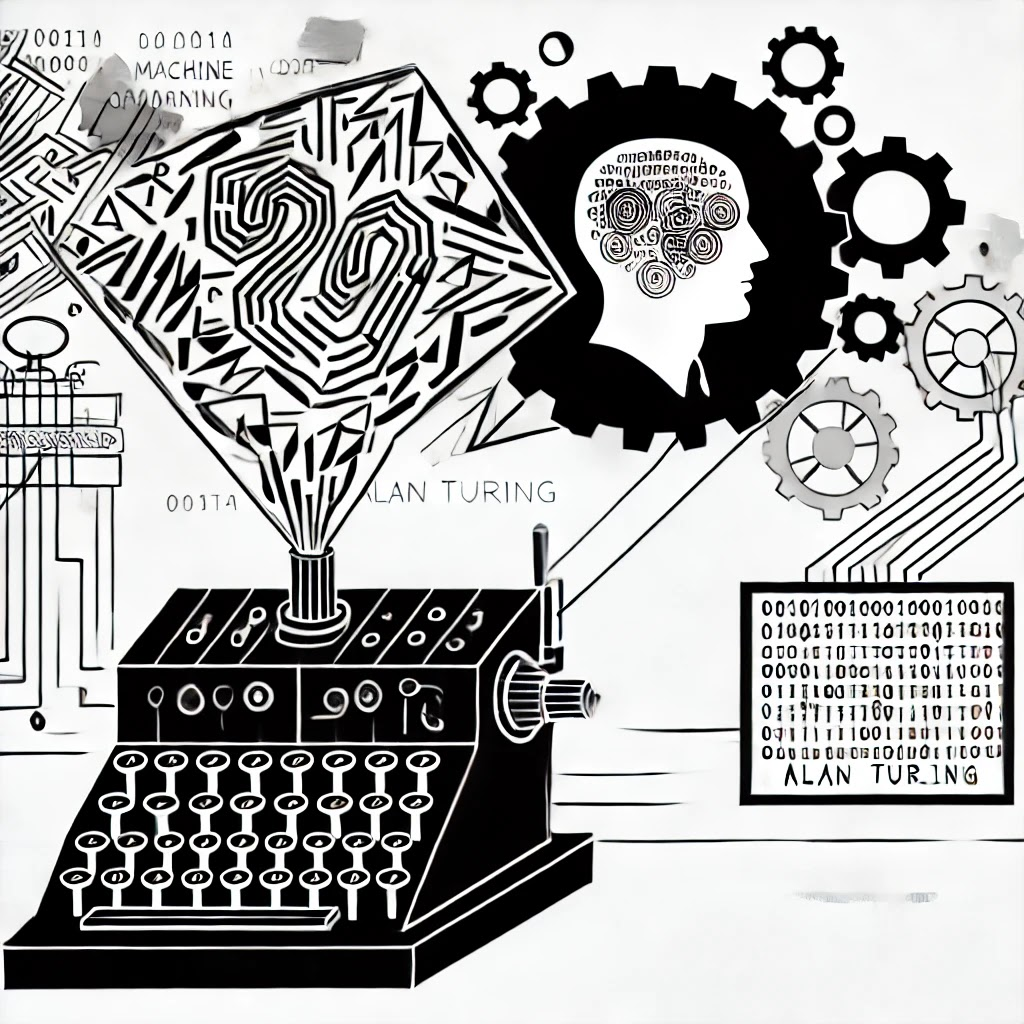
What I always found interesting is the history of both of my professional passions: Artificial Intelligence and Cybersecurity/Cyberwarfare, have a shared genesis moment- that moment is in the horrors of WWII.
The Beginning
The modern fields of Artificial Intelligence and cyberwarfare have their roots deeply embedded in the cryptographic efforts of World War II, specifically at Bletchley Park in England. This historic site, where some of the greatest minds of the time converged, became the birthplace of innovations that not only changed the course of the war but also laid the foundation for the technological revolution of the 21st century. At the heart of this pivotal moment was Alan Turing, a mathematician whose pioneering work would go on to influence both AI and the realm of cyberwarfare.
The Setting: Bletchley Park
During World War II, Bletchley Park was the epicenter of British codebreaking efforts. It was here that a diverse team of mathematicians, linguists, engineers, and intelligence officers worked tirelessly to decipher the encrypted communications of the Axis powers. The most famous of these was the Enigma code, used by the German military to secure their communications. The breaking of the Enigma, and later the Lorenz cipher, was a monumental achievement that significantly contributed to the Allied victory.
Alan Turing and the Birth of AI
Alan Turing’s contribution to the Bletchley Park efforts was nothing short of revolutionary. He developed the Bombe, an electromechanical device designed to help decipher Enigma-encrypted messages. But Turing’s vision extended far beyond the immediate needs of wartime cryptography. He was one of the first to conceptualize the idea of a “universal machine”—a precursor to the modern computer that could simulate the logic of any other machine. This concept was the foundation of Turing’s later work, which would become the basis for Artificial Intelligence.
Turing’s 1950 paper, “Computing Machinery and Intelligence,” posed the fundamental question, “Can machines think?” In this paper, Turing proposed what is now known as the Turing Test, a method for determining whether a machine could exhibit intelligent behavior indistinguishable from that of a human. This idea set the stage for the development of AI, as it framed the essential challenge of creating machines capable of learning, reasoning, and problem-solving—skills that were initially developed and tested at Bletchley Park.
The Dawn of Cyberwarfare
The work at Bletchley Park can also be seen as the genesis of cyberwarfare. The very act of intercepting, deciphering, and manipulating enemy communications is a form of information warfare—a precursor to the cyber conflicts of today. The techniques developed at Bletchley Park, such as traffic analysis and cryptographic attacks, are still relevant in modern cybersecurity and cyberwarfare.
Turing’s work on the Bombe and his theoretical contributions provided the framework for the digital computers that would later become essential tools in both AI and cybersecurity. The ability to encode, decode, and protect information, as well as to exploit vulnerabilities in enemy systems, are all foundational aspects of cyberwarfare. The legacy of Bletchley Park thus extends beyond the immediate victory in World War II; it laid the groundwork for the ongoing digital battles that define much of today’s geopolitical landscape.
Bletchley Park, under the direction of Alan Turing, was not just a codebreaking center but the birthplace of ideas that would shape the future of technology. Turing’s vision and the collective efforts of the Bletchley Park team set the stage for the development of Artificial Intelligence and the emergence of cyberwarfare. As we look back on the legacy of Bletchley Park, it is clear that the innovations born there continue to influence our world, driving forward the capabilities of AI and defining the parameters of modern cybersecurity. The pioneering work of Alan Turing and his colleagues at Bletchley Park remains a testament to the power of human ingenuity in the face of adversity, with a legacy that endures in every computer, every algorithm, and every encrypted message we send today.
 Eric C Richardson