If you work in cybersecurity or artificial intelligence today, you have likely suffered through your fair share of absolute nonsense Hollywood “hacks.” We all know the tropes: green text flying across a screen at terminal velocity, a protagonist fiercely mashing random keys, and someone screaming “I’m in!” just in time to save the world, every time I hear or see that line I cringe the deep cringe of annoyance. It is just painful exercise in suspension of disbelief.
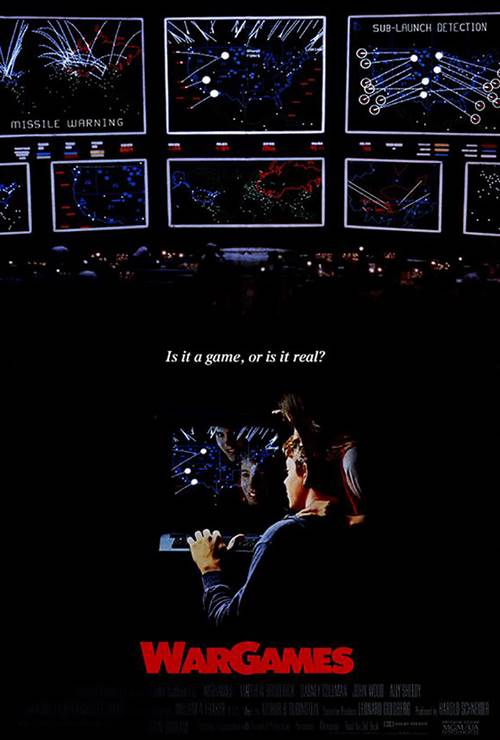
But forty-three years ago, a movie hit theaters that didn’t just respect the foundational logic of technology—it actually terrified the leader of the free world so deeply that it fundamentally altered United States national security law.
That movie was the 1983 sci-fi thriller WarGames, I was just finishing my junior year of high school already with plans to go into Computer Science, and I was fascinated with the idea of Artificial Intelligence, but in the 80’s our over optimistic view of AI was that in just a few years we’d be where we are not in the 2020’s, ahh the optimism of youth.
The Camp David Screening That Sparked NSDD-145
In June 1983, President Ronald Reagan spent a weekend at Camp David, where he watched an advance screening of WarGames. The plot follows David Lightman (played by a young Matthew Broderick), a brilliant high school kid who accidentally hacks into a military supercomputer and nearly triggers World War III after mistaking a nuclear war simulation for a new computer game.
When Reagan returned to the White House the following Monday, he interrupted a serious meeting on military strategy with the Joint Chiefs of Staff to ask a blunt question: “Could something like this really happen?”
The Chairman of the Joint Chiefs, General John Vessey, took the question seriously. He returned a few days later with a chilling answer: “Mr. President, the problem is much worse than you think.”
That exchange directly catalyzed the drafting and signing of National Security Decision Directive 145 (NSDD-145) in 1984. It was the first-ever presidential directive focused entirely on telecommunications and automated systems security.
So Reagan issued an executive order to strengthen cybersecurity practices just one year later. He didn’t really understand the broader impacts but many defense industry companies saw opportunities and fully jumped in.
When you really look at it WarGames remains a masterclass in systemic risk, totally un realistic but has enough nuggets of truth that it made for a great movie. It brilliantly highlights the catastrophic danger of connecting critical infrastructure to a learning machine without a human firmly kept in the decision-making loop.
Wardialing and the Vulnerability of the Human Element
To appreciate why the film holds up, we have to look at the technical realism of the opening act. David Lightman doesn’t bypass security using movie magic; he uses raw, systematic reconnaissance.
In 1983, long before ubiquitous fiber-optic broadband, the primary attack vector into any remote network was a standard analog telephone line.
[Attacking Terminal] —> (Automated Sequential Dialing) —> [Listening Modem] —> [Target Network]
David writes a script to sequentially dial every phone number in a specific Sunnyvale, California prefix, logging whichever numbers answer with a modem tone. This technique became so famous because of the film that the cybersecurity industry literally named it Wardialing.
When his computer finds an active modem, it turns out to belong to the WOPR (War Operation Plan Response) supercomputer. This sequence perfectly illustrates the flawed concept of Security through Obscurity. The military command assumed the WOPR was safe simply because its phone number wasn’t publicly listed. But as modern red teams know: if a modem or a port is listening, a threat actor will eventually find it. It is entirely a matter of time.
Secondary tools
While not a direct plot point we saw Lightman in the movie use a specific tone, of 2600 Hz, which could then trick some phone switches into getting free long distance calls. For those over fifty, remember when you had to meter our very minute when making long distance call? This showed that like any ‘hacker’ of the day would have many different tools in their toolbox to make gains. It’s not just about war dialing, social engineering remains to this day one of the largest open holes there is. The “wetware”, us humans, the always reliable weak link.
The Social Engineering Pivot
Finding the front door, however, is only half the exploit. To bypass the login screen, David shifts from a technical attack to Social Engineering. He researches the system’s creator, Dr. Stephen Falken, hunting through old academic papers and interviewing former colleagues. He ultimately uncovers a hidden backdoor password: “Joshua”—the name of Falken’s deceased son.
Dissecting the WOPR: Heuristics vs. Modern AI
If WarGames were remade today, the writers would undoubtedly throw around buzzwords like “Generative AI,” “Large Language Models,” or “Quantum Computing” to explain the threat. But the 1983 film got the computer science architecture exactly right for its era.
The WOPR is not an LLM. It doesn’t scrape data to write poetry or hallucinate legal briefs. It is a Heuristic-based Game Theory Engine.
| System Feature | 1983 WOPR Architecture | Modern Generative AI |
| Core Mechanism | Heuristic-based Game Theory | Deep Learning & Neural Networks |
| Objective | Strategic optimization of defined rules | Pattern recognition & statistical probability |
| Data Processing | Exhaustive decision-tree mapping | Vector embeddings & transformer architectures |
| Interface | Rigid command-line text | Natural language processing |
The AI Alignment Problem
The military high command trusted WOPR to control their nuclear launch capabilities because they wanted an automated response system that eliminated human hesitation. But in doing so, they ran headfirst into what we now call the AI Alignment Problem—the challenge of ensuring a machine’s objective function actually matches human values.
The WOPR does not understand the concepts of death, geopolitics, or the existential horror of mutual assured destruction. It only understands its mathematically programmed goal: to win the game. When the simulation starts, the machine treats a nuclear first strike identically to a move on a chessboard.
Even the UI/UX design reflects this mechanical coldness. While the giant glowing “big boards” in the NORAD command center are pure Hollywood spectacle designed to keep the audience visually engaged, the way the machine communicates with David is grounded in reality. It is entirely text-based command-line interaction—cold, rigid, and perfectly capturing the terminal culture of the early 1980s.
The Tic-Tac-Toe Logic Bomb
The climax of WarGames features one of the most elegant resolutions in science fiction history. To stop the computer from launching actual nuclear missiles, David forces the WOPR to play Tic-Tac-Toe against itself.
From a computer science standpoint, this is a brilliant demonstration of Reinforcement Learning navigating a Zero-Sum Game.
Tic-Tac-Toe is a mathematically solved game. If both sides play perfectly, the game will always result in a draw (a cat’s game). By forcing the AI to play against itself at lightning speed, David traps the system in an infinite loop of its own decision tree.
The WOPR runs millions of iterations, calculating every possible permutation of a nuclear exchange. It simulates US strikes, Soviet counterstrikes, and every tactical variation imaginable, searching for a path to victory.
[WOPR Explores Decision Tree]
│
├──> Scenario A: Total Devastation (No Winner)
├──> Scenario B: Total Devastation (No Winner)
└──> Scenario C: Total Devastation (No Winner)
│
[System Realization: Game Unwinnable]
Ultimately, the flashing screens fall silent, and the machine outputs its legendary final realization:
“A strange game. The only winning move is not to play.”
In the language of modern cybersecurity architecture, this is the ultimate lesson in risk avoidance. Sometimes, the only way to protect a truly critical asset from automated threats or systemic failure is to remove it from the board entirely via an air-gapped system which means physically disconnecting it from the network. the Most air gapped system is a computer running in a room with no connection whatsoever to the outside world.
Final Verdict and Legacy
WarGames deserves a resounding A+ for intent and conceptual accuracy. While the processing speeds of David’s home setup are heavily optimized for Hollywood pacing, and real military networks possessed tighter physical isolation protocols even in the 1980s, the underlying logic is incredibly sound.
The movie also commands massive respect for its attention to detail. David’s home computer isn’t a prop; it is a genuine IMSAI 8080 microcomputer system, complete with an authentic FDC2-2 floppy drive system—a beautiful nod to the hobbyist roots of the early personal computing revolution. See the image below for what that looked like.

We have come an astronomical distance since 1983.
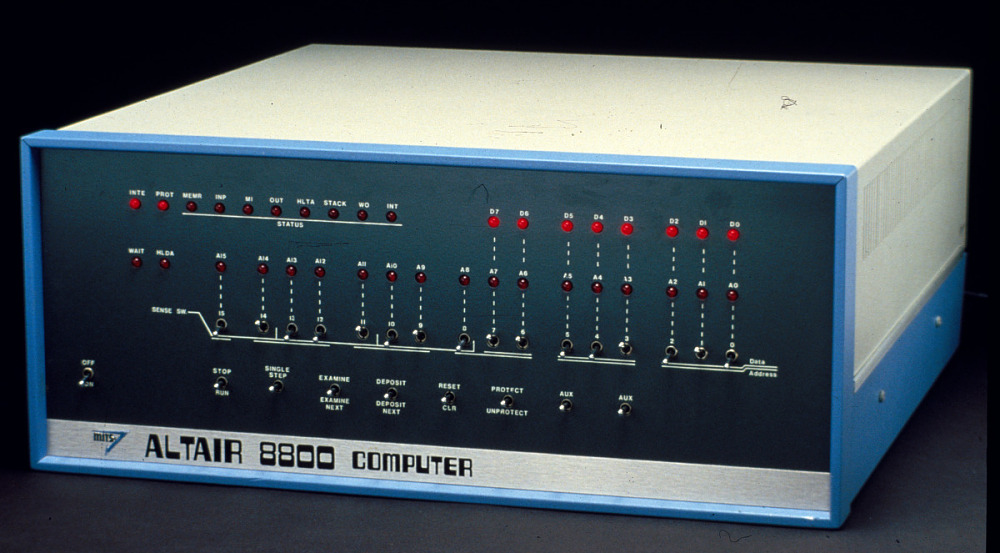
By the way the IMSAI 8080 was a ‘cousin’ of the computer I learned on starting when I was about 11, the Altair 8800 which was the PC that Gates and Allen started to write software for, their little company turned into Microsoft. I ended up moving across the country to work there for 17 years. GWBASIC programmers unite! Below is an image of an Altair 8800 identical to the one my Dad built, he still has the darn thing. Yes you used to boot it up by flipping switches to load information in and it didn’t have a keyboard or monitor at first, to a ten year old it still felt like Star trek.
We have traded acoustic couplers for multi-gigabit networks, and basic heuristic engines for massive neural networks. Yet, as we hand over increasingly more operational control to automated software and autonomous systems, the core
question of WarGames remains uncomfortably urgent: Have we actually fixed the “human-in-the-loop” problem, or are we just building a much faster WOPR? In Artificial Intelligence we often talk about having a human in the loop to ensure what’s coming out of your large language model is in fact tracking to real world expectations and is accurate, it’s not a new concept.
Like reading about AI?? I wrote a book on how Prompt Engineering here: https://shorturl.at/hBA0I